
The Creative Economy As Development Infrastructure
News

Economic development has earned some public skepticism. But indiscriminate cynicism is not accountability—and it is making it harder to recognize investments that actually strengthen our communities.
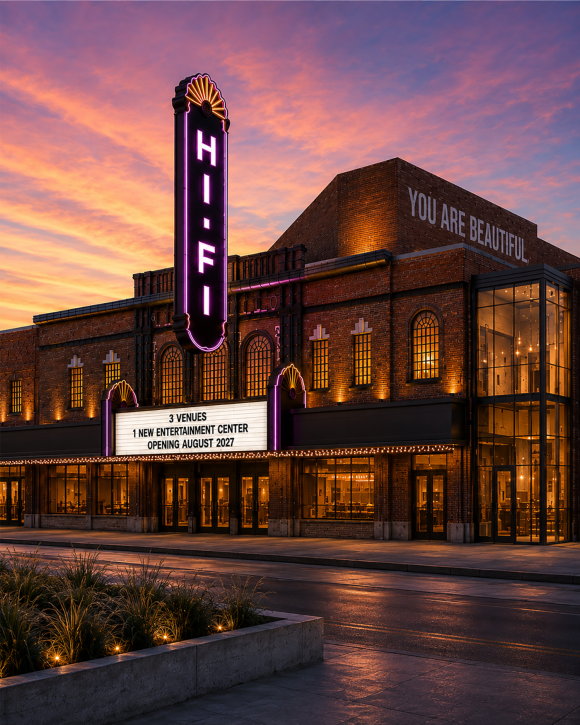
Last week, Indianapolis received genuinely good news: HI-FI was awarded a $1 million READI 2.0 Arts & Culture grant toward an approximately $5 million expansion of its independently owned music venues in Fountain Square.
The announcement should have been cause for celebration. A locally created company that has spent more than a decade building Indianapolis’ independent music scene had secured competitive funding to expand, hire people, support more artists, improve a historic building and bring more visitors into a neighborhood business district.
And most people did celebrate.
But a few immediately wanted to know why the money was not being spent on security, air conditioning, parking, seats, local artists or homelessness. Some assumed the grant was simply a million dollars in taxpayer money handed directly to a private business. Others lamented the loss of the Annex or worried that HI-FI would lose the intimacy that made it special.
Those last concerns are legitimate. People love the Annex. They value affordable tickets, small rooms and the ability to stand close enough to see the artist’s face. They should ask how the expansion will affect those things.
But there is an enormous difference between asking an informed question and assuming that an investment is wasteful, corrupt or harmful before taking five minutes to understand it.
To be fair, economic development has created some of its own credibility problems.
Communities have seen corporations receive enormous tax incentives while offering relatively few permanent jobs. Public agencies sometimes announce spectacular investment numbers without clearly explaining the cost, risk, accountability requirements or actual return to the community. Deals can be opaque, benefits can be overstated and politically connected interests sometimes do receive preferential treatment.
The current controversy surrounding data centers has poured gasoline on that distrust.
Indiana offers qualifying data centers sales-and-use-tax exemptions on equipment and energy for up to 25 years—and up to 50 years for projects exceeding $750 million. Local governments may also exempt qualifying equipment from personal property taxes.
At the same time, communities are asking reasonable questions about electricity and water use, noise, proximity to homes, transparency, infrastructure costs and whether the public benefits justify decades of tax relief. Indianapolis has been debating its first dedicated data-center zoning rules amid calls for tighter restrictions and, from some residents, a moratorium.
That debate is not irrational. Those projects involve global corporations, significant resource demands and potentially enormous public subsidies. They deserve serious scrutiny.
But the controversy has also conditioned people to see the words “IEDC,” “grant” or “economic development” and immediately conclude: corporate giveaway.
That is where skepticism stops being useful.
Economic development is not one single mechanism. A 50-year sales-tax exemption for a multinational technology company is not interchangeable with a restricted arts-and-culture grant supporting part of a locally financed capital project. A tax abatement is not the same as a loan. A loan is not the same as a grant. State tax revenue is not the same as philanthropic funding administered through a state agency.
If we do not understand what kind of transaction we are looking at, we cannot meaningfully judge whether it is a good one.
HI-FI was awarded $1 million toward a project expected to cost approximately $5 million. The grant is one piece of a larger financing package involving private investors, corporate partners and community stakeholders. Southeast Neighborhood Development, or SEND, is serving as fiscal agent, providing financial oversight and administrative support.
The funding comes through the READI 2.0 Arts & Culture Initiative, a $65 million program supported by Lilly Endowment and administered by the Indiana Economic Development Corporation in partnership with the Indiana Arts Commission. Nearly 320 proposals representing $1.4 billion in potential projects were submitted, and 49 projects were selected through a competitive review involving IEDC, the Arts Commission and outside industry experts.
In other words, this was not a million-dollar blank check handed to my buddy Josh Baker so he could buy better beer and install a few ceiling fans.
It is also a reimbursable grant—not a million-dollar check deposited into HI-FI’s account upfront. HI-FI must undertake the work, incur eligible project expenses and submit the required documentation before grant funds are released. The award covers approximately one-fifth of a major construction project, meaning the team must still assemble, manage and put at risk millions of dollars from other sources. That structure provides accountability while ensuring the grant pays for actual project costs rather than functioning as unrestricted operating money.
And what does the project create?
HI-FI will expand to approximately 550 people while retaining its smaller concert format. LO-FI will move to a new 200-person space intended for emerging artists, comedy, community programming and private events. A new 1,100-person performance hall will accommodate larger concerts year-round. Together, the three connected venues will have a combined capacity of 1,850. HI-FI projects that the expanded operation will attract more than 150,000 visitors annually, including an estimated 65,000 additional visitors to Fountain Square—particularly during the quieter months between November and April.
That gives artists a locally and independently operated progression from a 200-person room, to 550, to 1,100 seats. Artists who build an audience at HI-FI will have somewhere to grow without immediately moving into a venue controlled by a national concert corporation.
That matters culturally.
It also matters economically.
It is easy to think of a music venue as an amenity: a nice place to see a band, have a drink and spend an evening.
Economically, that is not what a venue is.
First, the $1 million award helps move forward an approximately $5 million capital project. The grant represents about 20% of the total investment, meaning it helps unlock roughly four times its value in additional project funding.
Before the first concert is played, the award is already supporting construction, equipment purchases, architecture, engineering, professional services and property improvements. HI-FI has selected Indianapolis-based Cambri Builders as the project’s general contractor, keeping a meaningful portion of that activity within the local economy.
Then there is the recurring impact.
The expansion is expected to generate 65,000 additional visits to Fountain Square every year. Those people do not simply buy a concert ticket and vanish. They park, take rideshares, eat dinner, buy drinks, visit nearby stores and sometimes stay overnight.
The National Independent Venue Association’s (NIVA) first Indiana economic-impact study offers a useful benchmark. In 2024, approximately 2.29 million fans attended independent live performances in Indiana and generated $80.3 million in off-site tourism spending. That works out to roughly $35 in spending outside the venue for every person attending an independent show.
Applying that statewide average to HI-FI’s projected 65,000 additional annual visitors suggests approximately $2.3 million in new off-site spending each year.
That is not a formal economic-impact projection for HI-FI, and it should not be presented as one. Some attendees will spend nothing outside the venue. Others will buy dinner, drinks, transportation or lodging and spend considerably more. But the statewide data gives us a credible way to understand the possible scale.
At that rate, the additional neighborhood spending associated with the expansion could exceed the original $1 million grant during its first full year of operation.
Over ten years, the same calculation approaches $23 million in spending at businesses outside HI-FI.
And that does not include:
This is exactly how a catalytic investment is supposed to work. A comparatively limited grant helps unlock a much larger capital project, which then produces continuing economic activity year after year.
No, Lilly Endowment will not receive its million dollars back like a conventional investor, nor can we claim that a precise amount of tax revenue will return to government without a project-specific study.
But the economic activity generated in the neighborhood is likely to eclipse the value of the grant many times over.
The broader Indiana numbers (taken from the NIVA study) reinforce the point. Independent venues, festivals and promoters generated approximately $1 billion in total economic output in Indiana in 2024. The sector contributed $578.9 million to state GDP, supported more than 8,000 jobs, paid $300 million in wages and benefits and generated $97.4 million in state and local tax revenue.
Music venues are not marginal decorations on the economy. They are businesses that purchase services, employ workers, compensate artists, attract visitors and send customers into other businesses.
The return does not remain inside the performance hall. It moves outward through the neighborhood.
That is economic development.
Many people experience a music venue only from the audience side: buy a ticket, walk into a room, hear a band and leave.
Behind that experience is a risky, complicated and frequently unforgiving business.
The venue has to book artists far in advance, sell enough tickets, market the show, satisfy touring requirements, staff the building, manage security, maintain equipment, carry insurance, comply with permits and licensing requirements, handle weather disruptions and absorb the losses when a concert underperforms.
The economic data makes that tension clear. Even while independent live entertainment generated more than $1 billion in statewide economic output, 64% of independent stages nationally were not profitable in 2024. Rising artist fees, staffing costs, inflation, insurance, rent and competition from monopolies were among the sector’s most common challenges.
Artists deserve to be paid more. Venue employees deserve to be paid more. Local musicians deserve better opportunities. Audiences want tickets to remain affordable.
All of those things require revenue.
You cannot demand that venues pay artists more and then resent them for attempting to put more people in the room. You cannot say Indianapolis needs stronger support for local music while objecting whenever a local music business develops enough capacity to remain financially viable.
Growth does not automatically mean greed. Sometimes growth is what allows a valued independent company to remain independent.
HI-FI has operated since 2014. Its stages have hosted thousands of performances, from local and emerging musicians to artists who later became nationally recognized. This expansion is not based on a speculative promise from a company arriving in Indiana to collect an incentive package. It builds on more than a decade of visible work, risk and demonstrated demand.
That distinction should matter.
Then comes the inevitable question: “But what about [insert worthy cause here]?”
There is no shortage of urgent social and economic problems that deserve serious policy, sustained funding, dedicated resources and competent public leadership.
But those problems will not be solved by preventing an independent music venue from expanding.
A functioning society has to be capable of addressing multiple needs at once. Investment in one community asset is not automatically money taken away from another, especially when the funding comes from a restricted program created for a specific purpose. Invoking a worthy cause without examining whether the money could legally or practically be redirected does not advance that cause. It simply shuts down the conversation about the investment in front of us.
We cannot create prosperity by refusing to invest in businesses. We cannot create vibrant neighborhoods by refusing to invest in the things that bring people into them. We cannot retain talented young people while treating music, art, culture, entertainment and nightlife as frivolous extras that should receive attention only after every other social problem has been permanently solved.
That day will never arrive.
Scarcity thinking convinces us that someone else’s opportunity must have come at our expense. It turns every success into an injustice and every investment into evidence that someone more deserving was ignored.
It also makes us remarkably easy to manipulate. A misleading headline gives us just enough information to become angry but not enough to understand what happened. We react, deliver our verdict and move on—often without reading the announcement, examining the funding source or asking whether our original assumption was correct.
To be clear, not every economic-development deal deserves applause. Some are bad deals. Some incentives are too generous. Some impact projections are little more than PR.
But scrutiny should lead to better questions: Where did the money come from? What kind of funding is it? What must the recipient contribute? What accountability is required? Who benefits, and is the public return proportionate to the investment? That is true accountability.
I know Josh, and I want HI-FI to succeed. I have watched him and his team spend years creating opportunities for artists and building something Indianapolis did not have, often with very little recognition. That does not put the project above criticism. Questions about affordability, parking, accessibility, security, local bookings and the future of the Annex are fair. But those questions should not obscure the larger point: a locally founded, independently owned creative business has earned the opportunity to make a significant long-term investment in Indianapolis. And that is worth celebrating.
So celebrate HI-FI. And celebrate the artists, venue operators, builders, neighborhood organizations and local businesses that will benefit from this expansion. Celebrate the other creative-economy projects across Indiana that received support, too.
Ask good questions. Demand accountability. Then, when the investment is sound and the people behind it have done the work, cheer like crazy.
Indiana needs more of this—not less.

