
The Machines Are Making Us Musical Again
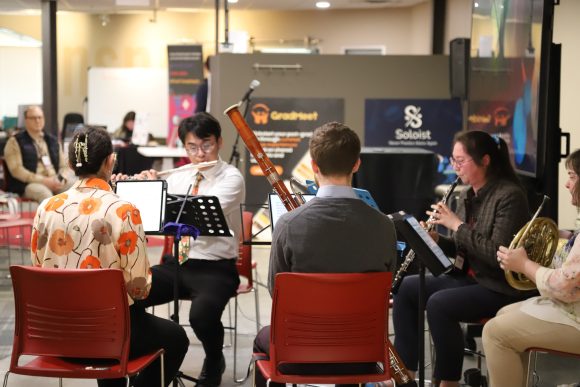
A dispatch from Algorhythms, where the conversation about AI and music kept circling back to something older than the industry itself.
I spent last weekend at Algorhythms in Bloomington, listening to people who build the tools, run the labels, write the checks, and perform the music argue about what AI is doing to the craft. The debate you’d expect showed up — licensing, attribution, the lawsuits, the slop. But underneath all of it, something quieter kept surfacing. Not a technology story. A rediscovery.
For most of human history, music was something people did together. Shepherds in the hills carved reed flutes in the spring, played them across valleys, and let them wither by nightfall. Parlor songs. Church choirs. Kids on porches. Folk music, which is to say cover songs — the same melodies passed hand to hand, each player making them their own. The twentieth century is the anomaly, not the default. It’s the century we turned music into a product, then into a file, then into a stream, then into an algorithmically optimized mood.
AI, strangely, is dragging us back toward the older pattern.
Not the headline version of AI — the Suno-generates-a-hit-nobody-asked-for version. That story is real and it matters, but it’s the smaller story. The larger one is what happens when the barrier to making a song collapses to nothing. Suddenly people who would never have called themselves musicians are writing songs for their kids, remixing their friends’ voices, building tracks on their phone on the bus. Dimitri Vietze, (Founder and CEO of Rock Paper Scissors, Inc) who gave the keynote, put it sharply: when music becomes frictionless to create, it becomes frictionless to ignore. He’s right about the commercial ceiling. But he’s describing only half the room. The other half is people making songs they never intend to sell, for audiences of six, because it turns out making something with other people is one of the oldest joys we have, and we’d mostly forgotten it was available to us.
This is where I keep getting stuck, in a good way. We are creative because we were made in the image of a Creator. That’s not a marketing claim; it’s why frictionless generation feels hollow and participation feels like oxygen. Blanco Brown, the country artist whose voice was cloned by an AI-generated act called Breaking Rust, said AI ‘tried to copy my soul’ — and failed.” I think he meant something precise. A machine can pattern-match the past. It cannot sit in a room with three friends and a cheap guitar and make the thing that happens when people are present to each other.
The industry question — who owns what, who gets paid, who counts as an author — is a real question and it will eat a decade of legal fees. But it’s downstream of a more interesting one: what do we want music to be? If we decide it’s primarily a product to be generated, licensed, and consumed, we’ll keep fighting the fight we’re in. If we decide it’s primarily something people do together, the policy questions change.
For Indiana, that second framing is a gift. Our instinct in creative economy conversations is to measure output: how many records pressed, how many streams logged, how many festivals booked. But output is not the interesting number anymore. Participation is. The question isn’t just whether Indiana can produce the next star; it’s whether we can be a place where tens of thousands of people play music with each other on a regular basis. That means investing in the rooms where that happens — the basements, the church halls, the indie venues with 200-capacity rooms and sticky floors, the community music schools, the rehearsal spaces priced for teenagers. It means treating a thriving local scene as infrastructure, not amenity.
The builders and the prompters and the rights administrators will all keep doing their work. Somebody will figure out attribution. Somebody will win the streaming argument. Those matter. But the thing AI has accidentally exposed is that the most interesting frontier in music right now isn’t technological. It’s social. The future of music might not be better songs. It might be more people making them together, in rooms we had the wisdom to keep open.
That’s the Indiana bet worth making. Not chasing the next platform. Building the density — human, physical, local — where creativity is a thing people do with each other, not a thing they consume alone.