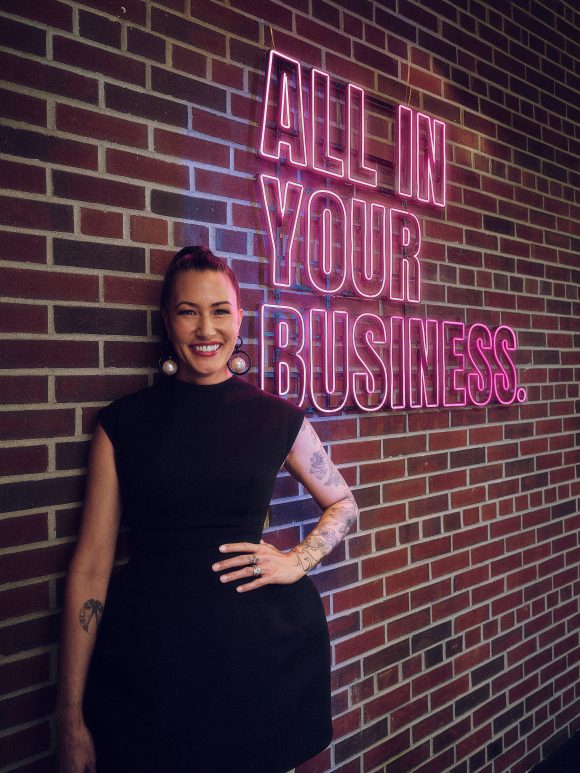
Photography by Jay Goldz; Style by Katie Marple; MUA: Deetra Mason; Cover design by Jacob Chaves
Katie Clements never planned to run an advertising agency. She wanted to make things. More specifically, she wanted to paint, until her parents informed her they weren’t paying tuition for that. So she minored in painting instead, studied graphic design at Ball State, and began the long progression from designer to art director to creative director.
Today, Clements is a partner and co-president of CVR, the 116-year-old Indianapolis advertising agency where she has spent more than a decade. She shares the top job with Blake Lofgren, her longtime colleague and fellow partner, as the two take on the next generation of leadership at one of Indiana’s oldest creative businesses.
The job looks different these days. Clements estimates only about 20 percent of her time is still creative; the rest is largely meetings, leadership and figuring out what an independent agency needs to become next.
That question feels particularly urgent now. Clients want more content, faster and cheaper. AI is changing what can be produced, how quickly, and potentially who gets hired to produce it. Meanwhile, CVR itself recently rebranded around a desire to become more strategic and less of what Clements calls a “production agency.”
For someone who came up making the work, Clements now finds herself protecting the people who make it—giving creatives room to play, delivering difficult feedback without creating a toxic culture, and creating paths for young people who may not realize creative work can become a career.
And, perhaps unsurprisingly for someone who has spent her career thinking visually, she also showed up for our cover shoot with one of the best wardrobes we’ve had in the series.
Shot on location at the CVR offices, downtown Indianapolis.

PO: You started as an art director and spent most of your career on the creative side. Did you ever imagine that you would eventually be running an agency?
KC: No. All I wanted to do was be an artist and be creative. I wanted to be a painter, however my parents said they’d only pay for school if I selected a career that provided stability. So I majored in graphic design and minored in painting.
After a fairly humble start to my career serving tables and working retail, God opened doors into agency life. I dedicated myself to showing up, doing things the right way and being kind. It’s taken a while, but people have recognized my effort and I’m grateful to have been elevated.
I do miss doing creative work, but now that I’m running an agency, I feel like I’m an advocate for artists. I understand what it feels like to start as a designer and try to make your way up through an advertising agency.
I don’t think everyone understands what creatives need to thrive. That’s been my contribution to the space. Artists need time to play. They need time to think and let ideas develop. Deadlines are deadlines, but if they aren’t provided the time or freedom to actually tap into their gifts and talent, I’m not sure you can ever expect their best work.
PO: How much of your job is still creative?
KC: Probably 20 percent creative and 80 percent leadership.
That’s something I’m trying to figure out: How can I be in fewer meetings and spend more time supporting design? Especially now with AI coming out, we’re trying to figure out how we most ethically and responsibly use it without taking away human creativity.

PO: How is CVR approaching AI?
KC: It reminds me of when social media first came out. People were saying, “It’s just a fad. We’re not going to need to use it.” Then clients started asking about Facebook. Now a significant portion of client work includes social media services.
When AI first came out, we created a committee of people from every department. At first, we thought about it mostly as creative output, and we came at it defensively: How are we going to use it? When aren’t we going to use it? We have clients with proprietary information, so we knew there was a need for guardrails right from the beginning.
When we started talking to other agencies we heard others use it for project management and internal efficiency. It wasn’t necessarily about creative output.
We surveyed our employees about how they felt regarding AI. There were some who were adamant about not using it at all. Others were cautious and were unsure about the right way to use it. What was clear was that we were not going to lean on it for creative purposes but needed to learn more about how to use AI as a tool. Blake and I brought a consultant in to demonstrate AI’s capabilities and then sent each department away to have conversations about how they see it best being leveraged.
PO: What worries you about it?
KC: I’m worried that the current trend will encourage organizations to depend on AI outputs for convenience and savings. However in doing that, human creativity and quality will be diminished. I compare it to fast-fashion. We went through a few years when purchases were focused on the occasion of the day. We weren’t concerned with quality. Buy it, wear it, and get rid of it.
That trend has run its course. Quality is starting to come back. People don’t necessarily want a new fast-fashion outfit for every occasion anymore. They’re buying vintage. They want classic pieces. They want something of quality.
I’m hoping that happens with advertising, too.

PO: You describe your leadership philosophy as “people first.” That sounds great until someone’s work isn’t good enough or you have to tell somebody something they don’t want to hear. What does people-first leadership look like then?
KC: My husband, Dr. Bwana Clements, is a therapist, and one day he told me, “Katie, being nice is not kind.”
That really stuck with me.
If you care about somebody, you tell them the truth, even if it’s hard. I’ve tried to model accountability for myself and for others. That’s not easy work. Like relationships, parenting, getting in shape, or growing professionally, it’s our willingness to do the hard things that makes us grow. If you’re afraid of conflict, I believe you’ll struggle as a leader.
If you want to advocate for people and truly be people-first, you have to listen more than you talk. You have to understand the perspective of others. Genuinely care about others.
One thing I love about CVR is that we are an agency that prioritizes work culture. We are intentional about creating an atmosphere where it is safe to show up as your true self.
PO: CVR is 116 years old. Now you’re one of the people responsible for its next chapter. Does that history feel like an asset or a burden?
CVR has a long and storied history in our city. It carries a strong reputation for putting out quality work. Most of that work has been focused on business-to-business rather than business-to-consumer. As an artist, of course, business-to-consumer is what most designers would call the fun stuff. We’ve proven business-to-business can be creative too.
Blake and I want to honor the legacy of CVR while intentionally moving it into a more strategically creative direction.
So it is a huge responsibility. I think, “I can’t eff it up.”
I think about it as a woman, too. CVR is the longest running advertising agency in the city. To have the baton be passed to me at this time, is not something I take lightly. I feel incredibly blessed to have the opportunity to lead.
PO: CVR recently rebranded. What did doing that work on yourselves expose?
KC: There has been ongoing conversation with Kevin Flynn and Matt Georgi about the transition of turning the company over to Blake and I. While we still have their support and mentorship, we thought this was a good time to get feedback from our clients and our staff to learn about what we are doing well and where we have opportunity to improve.
What we heard was: We want to do better work. We want to be more strategic. We don’t feel like the creative can do its best work because strategy and creativity aren’t collaborating.
So I told the creative team, “Okay, you take it. Leadership is going to be the client.”
That was hard for me because I had my own ideas. But I wanted them to show us who they wanted CVR to be.
They came back with three ideas, and we immediately picked “All In Your Business.”
For us, that means we want to be part of our clients’ businesses. We don’t want to just be a production agency. If you’re all in with us, we’re all in with you.
PO: What creative skill becomes more valuable because AI exists?
KC: Creative thinking. Asking good questions.
What you put in is what you get back out. If you can’t think creatively, if you aren’t able to listen and feel what your client is seeking to convey, the work will fall flat. This is the advantage of the human experience. AI can’t replace soul.
Advertising has gotten to a point where everything looks the same. Everything is safe. Nobody wants to do something weird or controversial or edgy.
We’ve got to trust that our creativity, our commitment to listening, and our passion for connection will produce good work.
PO: Let’s talk about the creative economy. How do you think about an advertising agency like CVR as part of that ecosystem?
KC: We’ve been trying to expose more young people to creative careers. We created a scholarship a couple of years ago because fewer people are going to school for art, especially young people of color. Arts are being taken out of public schools, and families are scared that if their kids go to college, they need to study engineering or something where they know they can get a job.
I tell people: You can do art. Look at me.
My son is studying landscape architecture at Purdue. My daughter is at Ball State studying acting. I tell them, “Do your dream.”
We’re scaring people into thinking you can’t be creative and make a living, or that you have to be a starving artist, or do it on the side, or AI is going to take your job.
Eight years ago, we hired one person for video work. Now we have six people in our video department, and it has become one of our superpowers because storytelling has become critical to growing business in this economy.
PO: After all these years in the industry, how do you see advertising in Indianapolis right now?
KC: I actually think it’s thriving.
Most of the advertising agencies I knew when I started are still around, and there are a lot of smaller niche agencies doing really well. There used to be a strong competitive spirit in the advertising community. I think that has diminished over time as people are understanding there is enough work for all of us. We can actually collaborate and support one another.
What scares me , however, is big corporations thinking, “We’ll bring somebody in-house,” or, “We’ll use AI,” to produce fast but uninspiring work.
Hiring an agency can be expensive, but it can be more expensive to do the expedient and cheaper work and your campaign doesn’t get the traction you anticipated. As the saying goes, “You only get one time to make a first impression.”
I hope it swings back. Trends usually do.
PO: What does Indy do well as a creative market that outsiders might underestimate?
KC: I feel like we have a lot of community events and places where people can meet each other: Bigger Picture Show, Creative Mornings, CAMI, First Fridays, etc. Indy understands the importance of creating and prioritizing artistic outlets.
The creative community gives people opportunities if they take them.
You don’t necessarily need a lot of money. You don’t have to know somebody to get in. In bigger cities, sometimes it feels like if you don’t know somebody, you can’t participate.
And then once you go, you hear about something else.
I just wish more people knew all of this was happening.
PO: You had your own version of that experience when you first moved to Indy, right?
KC: I couldn’t find a job after college, and I was still working as a server. I wasn’t meeting anybody creative.
My twin sister, Sarah Stewart and I were driving down College Avenue and saw ModPod Homethings. This home retail store was before its time. It was a niche, high-end furniture and creative boutique. We walked in, met Morgen Kemper, and basically said, “Would you hire us?”
We met so many people in the creative community because it was such a unique store. Mindy Taylor Ross worked there with me. Eventually she introduced me to the Indy Arts Council.
That’s when I learned about the Creative Renewal Arts Fellowship and everything they offered.
But I didn’t know any of it existed before. One experience led to another. I took advantage of each opportunity given to me and saw each experience as a way to build a creative career.
PO: Ten years from now, what would have to be true for you and Blake to say you left CVR stronger than you found it?
KC: It’s about authentically living the tagline, “All In Your Business.” For me, that means fully seeing and valuing the people who choose to work for CVR and showing up for our clients in a meaningful way. The CVR brand is not just what we want it to be, it’s what we demonstrate it is first to ourselves and then to those we serve and share community with. I truly believe that when we show up with kindness, when we set one another up for success, and when we encourage everyone to share their ideas we end up with wildly successful work that our clients love. Ten years from now, my prayer is that Blake and I have curated a space where people, both staff and clients, are bringing their best ideas to life.