

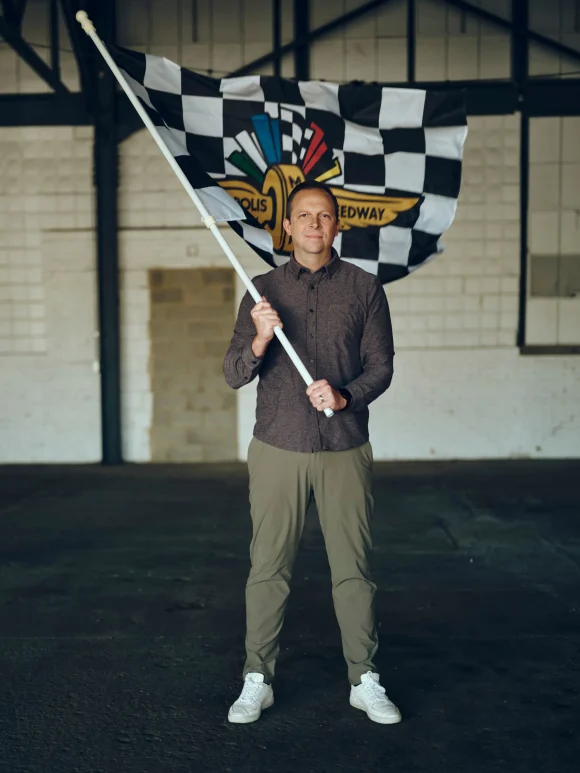
Photography by Jay Goldz; Cover design by Jacob Chaves
Dave Neff did not grow up thinking of himself as creative. Sports came more naturally than sketching, and like many people, he once understood creativity as something reserved for artists. Over time, that definition expanded. Creativity, he says, can also show up in how people are brought together, how a physical space is activated, how an event is built, and how something is created out of nothing.
That broader understanding feels especially relevant now. As president and CEO of the 500 Festival, Neff is leading one of Indiana’s most recognizable civic institutions—an organization that turns the Indianapolis 500 from a single-day race into a statewide season of community, education, public celebration, and economic activity.
Founded in 1957, the 500 Festival exists to produce life-enriching events for Hoosiers, drive positive community impact, and celebrate the spirit and legacy of the Indianapolis 500. Its best-known events—the Mini-Marathon and the Parade—are only part of the story. Behind the scenes is a year-round operation with 18 full-time staff, a dozen seasonal interns, thousands of volunteers, statewide education programs, corporate partnerships, youth fitness initiatives, and major civic events that draw people from across Indiana, the country, and the world.
The impact is cultural, civic, and economic. According to the organization’s most recent annual report, 500 Festival events generate an estimated $22 million in annual economic impact, including $6 million in direct spending by out-of-state visitors. For Neff, the Festival is not just a beloved May tradition. It is connective tissue: between the Indianapolis Motor Speedway and the community, between sports and civic pride, between economic development and quality of life. And as Indiana continues to think more seriously about its creative economy, the 500 Festival offers a useful case study in how shared experiences become infrastructure.
Polina Osherov: Were you creative as a kid?
Dave Neff: I didn’t think of myself as a creative kid. I was a terrible artist. I couldn’t sketch, and I felt insecure in art classes. I definitely leaned more toward sports—soccer, basketball.
For a long time, I believed the lie that creativity meant you had to be artistic. My view on that has evolved over time. Creativity can be how you bring people together, how you architect an event, or how you combine a physical space with a speaker or an experience. There’s creativity you bring to bear when you create something out of nothing.
PO: You’ve had a career that spans sports, business, civic life, and community leadership. Where does your civic-mindedness come from?
DN: I grew up in Indianapolis and am a proud native son of Indy, but I didn’t necessarily grow up in a super civic-minded household. My father was a family practice physician and a good dad. He saw patients, came home, took us to sporting events, and went to church. But we weren’t doing all the civic things all the time.
A lot of the inspiration for why I’ve gotten so involved in the community came from starting my career in 2007 at Pacers Sports & Entertainment. Working for the Pacers, it’s hard not to observe how the city works.
When we bring a Big Ten Tournament, a Final Four, or a Super Bowl here, you see how the CIB, Indiana Sports Corp, Visit Indy, Downtown Indy, and all these different groups work together to collaborate and pull off events. I didn’t even know in high school that Indianapolis was building this reputation as the amateur sports capital of the world. Once I got to the Pacers and saw it, I became curious about how it all worked.
PO: Who influenced that view of civic service?
DN: Jim Morris, more than anyone.
He started at the Pacers about six months after me. I didn’t know Jim from Adam at the time, but I quickly figured out it was a big deal that we had hired him. Then, as I studied what he had done—from being Dick Lugar’s chief of staff when Lugar was mayor, to becoming president of Lilly Endowment, running the water company, serving with the United Nations World Food Programme, and sitting on so many nonprofit boards—I saw a model.
Jim never had an agenda. He was doing it to help others and to be as useful as possible. He modeled that for so many of us. I only worked for the Pacers for four years, but I maintained what I felt was a pretty strong relationship with him until the day he died in July 2024.
There have been others, too—Allison Melangton, Mark Miles, and other people around Indy civic life. Obviously, because I come from a sports business background, I probably see more of that ecosystem.
PO: What do you think the next generation of civic leaders needs to understand?
DN: Jim always said, “You never feel as good about yourself as when you’re doing something for someone else.” I think that’s true.
I’m in an interesting stage of life, in my early 40s, where my peers are starting to have some career success. I see some people solving mostly for lifestyle—taking four vacations a year and that sort of thing. There’s nothing wrong with that, but I also think: why not carve off some time and serve on a school board, or another civic organization?
Barry Wormser is a great example of someone serving in multiple places. We need more Barrys!
Jim and his peers gave us a tier-one city. Jim would tell me that back in the 1970s, we were a tier-four city. There wasn’t much going on downtown. A couple of hotels, maybe one restaurant. What we have now is not guaranteed to continue forever without the next generation of civic-minded people stepping up.

PO: The Indy 500 is one of Indiana’s most recognizable assets. How do you think about the 500 Festival’s role in extending the meaning and impact of May beyond the race itself?
DN: At our core, we are a community organization. We exist for three reasons: to produce life-enriching events for Hoosiers, to drive positive community impact, and to celebrate the spirit and legacy of the Indy 500. That is our mission. It’s what the four co-founders came up with in 1957, and it’s still true today.
I’ve used this analogy in other settings: if IMS is our state’s crown jewel—if you travel outside the U.S. and say you’re from Indiana, generally one of the first things people say is “Indy 500”—then the Festival is the soft connective tissue around the crown jewel.
Some people might call us the community engagement arm of IMS. We partner very closely with them, and they’re very supportive of our efforts, as we are of theirs. We’re always talking about how to extend the reach and impact of May.
PO: The 500 Festival produces more than 30 events and programs for more than half a million participants annually. What does it take operationally to pull that off?
DN: We have a relatively lean full-time staff of 18 that produces everything we do. Then we have a dozen interns with us from January to May.
But we also rely heavily on our volunteer army. This year we had 2,700 volunteers. That includes everyone from the people manning pit stations during the Mini-Marathon—the Mini itself had close to 900 volunteers—to volunteers who come with us to elementary schools around the state to help educate fourth graders about the history of IMS, driver nutrition, and how IndyCars work.
We have volunteers who will drive to Berne, Goshen, Evansville, and other communities to partner with us. We have people holding the strings attached to floats or balloons during the parade. We have volunteers helping with the 500 Festival Princess Program.
There’s a bit of a misnomer that we only exist two or three months out of the year. But the planning and preparation required to underwrite these things from a sponsorship standpoint, to execute the events, and to coordinate with the city and other civic organizations is year-round work.
PO: What parts of the Festival do people underestimate?
DN: People underestimate our statewide reach.
We engage about a third of all fourth graders in Indiana through our education program, which is roughly 25,000 fourth graders across the state. It’s a STEM-based curriculum that we’ve worked with academic partners to create.
In March, we do Mobile Trips, where we go out to schools around the state with an actual IndyCar. Students move through different stations and learn about the history of IMS, driver nutrition, what drivers wear, and different aspects of motorsports, including motorsports as a potential career path.
In April, we do Study Trips at IMS. For 10 days, we have about 800 fourth graders a day come to the track. They get to kiss the bricks, walk around the Speedway, and go through different stations. Some mirror what happens during the Mobile Trips, but there are more experiences because they’re actually at the track.
PO: What other youth programs are part of the Festival?
DN: We also have KidsFit, which reaches another 20,000 kids. They run or walk a mile a week over a 13-week timeframe, which builds up to essentially accomplishing a half marathon. We’re trying to get them on the continuum of maybe one day running a 5K or the Mini-Marathon.

PO: What are some of the major community events people should understand as part of the Festival?
DN: The first Saturday in May is always the Mini-Marathon. The fourth Saturday is always the Parade. The third Saturday is Breakfast at the Brickyard. This year we had 80 mayors from around the state at that breakfast. Indiana has 122 mayors, so we had almost three-quarters of them present.
The second Saturday in May is Kids Day and Rookie Run, where we take over Monument Circle and all four spokes. There are more than 100 activations with organizations like the Pacers, Fever, Colts, and Junior Tennis League. It’s the state’s largest free festival for families and kids.
We also host a three-mile, six-mile, and 10-mile race in February, March, and April. That’s about 2,000 people per race. We call it our Miler Series, and it’s a good build-up to running the Mini in May.
PO: If you think of the Festival as an economic engine, who benefits directly and indirectly?
DN: Since its founding in 1957, the Festival has generated more than $500 million in estimated economic impact for Indianapolis.
The Mini-Marathon has participants from all 50 states, six continents, and a couple dozen countries. We’re bringing a lot of people to Indiana.
Then, with the Parade, the Miler Series, Kids Day downtown, and other major events, people are coming into the city, going to restaurants, and doing other entertainment beyond the events themselves. Kids Day brings about 15,000 kids and families downtown. So yes, we are absolutely getting people out, engaged, and spending money in the local economy.
PO: Do you have a particular vision for how the 500 Festival should evolve under your leadership?
DN: I’m still learning, and this is different from some of the more entrepreneurial things I’ve done, like EDGE or Boilermaker Alliance. This is our 70th year. There are traditions and cultural pieces that I imagine we will always have: the Parade, the Mini-Marathon, the Princess Program. Can we look for ways to make them better or enhance them? Absolutely.
As I think about the next 70 years, I come back to those three missional pieces: producing life-enriching events for Hoosiers, driving positive community impact, and celebrating the spirit and legacy of the 500.
Could we do more programming? Yes. We’re going to do corporate member events this summer and fall. But what are some things we could do year-round, perhaps even out to the four corners of the state? The education program and KidsFit are a great start. We’ve also talked about whether IMS, the IMS Museum, and the Festival could be doing things when IndyCar season is not in session to engage communities around Indiana. I don’t want us to be focused only on Central Indiana.
PO: Are there past Festival traditions you might bring back?
DN: Yes. The Snake Pit Ball was a big hit. The last year we had it was 2019. Some might say it was a COVID victim. I’m not making any guarantees, but we are having conversations about maybe bringing that back to life.
PO: How would you describe the posture of the Festival right now?
DN: You’re going to see us play offense. You’re going to see us be very visible in the community.
I’ve already gotten feedback that our brand presence and storytelling are resonating more. I think there’s a new energy around the Festival. The Festival is open for business. If other civic organizations want to collaborate, let’s figure it out.
We can really do anything, but we can’t do everything. That’s where our next strategic plan will help us answer some key questions. I don’t know if we’ll get it done this year or in 2027, but that process will help guide what comes next.
PO: What would you tell economic development leaders who still think of festivals and cultural events as nice-to-have rather than infrastructure?
DN: Festivals and cultural events are a quality-of-life and a talent attraction play.
They are absolutely a need-to-have. Without this type of activity, you’re going to lose. People are looking for more than professional sports teams. They want to know what else there is to do throughout the year, whether they’re young and single, married with no kids, raising a family, or empty nesters.
I had lunch with Dennis Murphy, CEO of IU Health, recently, and he made that point directly. IU Health is attracting talent from all over the country, and having the Mini-Marathon and all these great events in the spring and throughout May is a huge talent attractor in their efforts to bring the best doctors, nurses, and administrators here. That matters. These events help people see Indianapolis as a place where they can build a life, not just take a job.
Cultural events and festivals are opportunities to build community. At its core, I think Indianapolis Motor Speedway is about building community. Doug Boles has said that. Yes, when you have 350,000 people at the largest single-day sporting event in the world, the race is the centerpiece. But it is about much more than the race. The Snake Pit is a perfect example. There are 25,000 people in Turn Three who are there for the music, the energy, and the experience. That’s the point: there is a little bit of something for everyone.