
The Creative Economy As Development Infrastructure
News

I keep finding myself in Elkhart.
This spring it was IDEA Week. In June, we came back for the second stop in Pattern’s Indiana Music Economy Sessions. In between and since, other projects have kept pulling my attention toward the South Bend–Elkhart region.
At a certain point, you start wondering whether the repetition is trying to tell you something.
For the music session, our team stayed at Hotel Elkhart, the lovely old building on Main Street that opened as a grand hotel in the 1920s, spent later chapters of its life as assisted living, offices, restaurants and apartments, and eventually became a hotel again in 2021. Today it is part of Hilton’s Tapestry Collection.
Which feels almost too on-the-nose for the point I’m trying to make.
Walk outside and The Lerner is just down the street. Another historic building brought back to life. Restaurants. Streetscape. People walking around. A downtown that increasingly feels like a place rather than simply a collection of buildings.
None of that happened accidentally.
A couple months earlier, during IDEA Week, Mayor Rod Roberson had talked about the Lerner while welcoming us to a panel I was moderating on “Creativity as Infrastructure.” He spoke about Elkhart’s decline, the decision to reinvest in the theater, and the role arts and entertainment have played in the city’s renewal.
But one line stuck with me more than anything else.
Elkhart’s soul, he said, “started with music.”
That makes sense when you remember that this is the city that built an identity around musical-instrument manufacturing. Conn-Selmer and the broader band-instrument industry aren’t simply random historical footnotes. Music is embedded in Elkhart’s industrial history.
Which made it especially fitting to return to The Lerner in June and ask a slightly different question:
What would it look like to treat music not just as part of Elkhart’s past—or as entertainment happening on individual stages—but as part of the region’s economic infrastructure now?
We started that day with a small stakeholder conversation involving tourism, economic development, philanthropy, municipal leadership and music-sector voices. Then we opened the conversation up publicly with Jon Hunsberger of the Elkhart County CVB, Grif Eaton of Juke, and Carl Thompson of The Lerner.
Elkhart was the entry point, but the conversation kept widening.
And the same thing kept surfacing. There is no shortage of stuff here. There are venues. Festivals. Musicians. Universities. Instrument manufacturers. Restaurants. Tourism organizations. Downtowns. Schools. Fairgrounds. Cultural institutions. Community spaces. Promoters. Music educators. South Bend has its assets. Elkhart has its assets. Goshen, Mishawaka, Wakarusa, Nappanee all have their own personalities. Shipshewana is unobtrusively running an entertainment machine that a lot of larger places could probably learn from.
The problem is that nobody wakes up every morning responsible for seeing all of it at once.
Which seems like a bit of an oversight.
Because a strong venue is not the same thing as a strong music economy. A successful festival is not a music strategy and a calendar is not an ecosystem just as a collection of great projects does not automatically become a regional competitive advantage. Someone or some structure has to connect the dots.
Then July happened.
The South Bend–Elkhart region received $9.15 million through Indiana’s READI 2.0 Arts & Culture Initiative.
The awards include funding for five projects, two of which are music-related: $3 million for the Howard Park Bandshell, and, notably, $350,000 to expand Music Town across the region.
So suddenly the conversation we had at The Lerner back in June feels a lot less hypothetical.
I’m especially encouraged that the region got the dollars to expand the Music Town program (built on top of the Juke platform) because it offers a useful case study in what relatively lightweight creative-economy infrastructure can look like. Plenty of restaurants, breweries and other businesses like the idea of live music. Far fewer have the time, relationships or experience to consistently book artists, promote shows, manage logistics and absorb the risk when something doesn’t work. For a business whose actual job is selling food, beer or coffee, adding live music can quickly become death by a thousand tiny tasks.
Music Town lowers that activation energy. Instead of asking every individual business to become an expert in live entertainment, it creates a shared layer of coordination, tools, visibility and support that makes participation easier. The result is not simply “more concerts.” It is more businesses capable of participating in the music economy, more opportunities for artists, more reasons for people to move between places, and, critically, more information about what is actually happening in the market.
Reduce the friction between idea and execution, and more economic activity becomes possible.
That is why I think other regions and towns with plenty of music assets but underdeveloped connective infrastructure should be paying close attention to what happens with Music Town in the South Bend–Elkhart region.
What I like about it is that the technical platform already exists. Juke is Indiana-based, it has already been tested in-market, and it is now being given the opportunity to scale across multiple communities in the region. (In a nutshell: Music Town is the packaged program that turns Juke from a calendar/product into a community development tool.) That matters because one of the recurring challenges I keep seeing around the state is not necessarily a lack of music or audiences, but a mismatch between the two: plenty of both, they just don’t really know how to find one another.
Which raises an interesting question. Rather than every city building its own platform from scratch, could some of Indiana’s more music-dense communities eventually plug into a shared system like Music Town and make it easier for audiences, venues and artists to find one another across markets?
I don’t know. But it feels like a logical next step worth watching. That does not mean every region should hand its music data to a private platform without asking hard questions. Ownership, access, portability and long-term cost all matter. But a tested Indiana-built tool is worth taking seriously, especially when the alternative is often another from-scratch pilot that never gets past the planning stage.
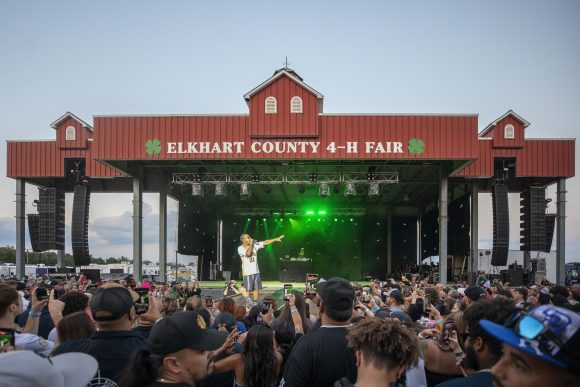
For Vol. 29 of PATTERN mag, we’ve been looking at Indiana’s creative economy through the lens of “creative trades”. That reporting took us to the Elkhart County 4-H Fairgrounds—another place that we don’t normally file under “creative economy.”
But we should!
Thousands of young people there are showcasing real, and highly transferable, skills through fashion, woodworking, photography, design, food, technology, performance and other hands-on projects. Meanwhile, the Fair itself is experimenting with entertainment outside what some assume its audience wants, and finding that some of those less-obvious choices can pull strongly from outside the immediate community.
Again: assets hiding in plain sight.
This is what has me increasingly interested in South Bend–Elkhart beyond the music work.
Creative organizations are building capacity. Historic buildings are coming back online. Tourism is at the table. State dollars are entering the system.
There is momentum. And momentum, I’ve learned, has a shelf life.
And here’s where these things usually break down. We’re never short on studies, plans or good ideas. We fund the planning, identify the gaps, agree on the priorities — and then stop just short of funding the people who carry the work forward. Implementation becomes the next phase, the future ask, the thing someone figures out later.
Except implementation is the whole point.
So when we invest serious time and money in strategic planning for economic impact, we should be funding at least three years of implementation alongside it from the start. Otherwise we’re producing excellent roadmaps with nobody paid to drive.
That doesn’t mean every recommendation happens or every plan needs a new organization. It means somebody needs the time, authority and resources to keep things moving — because otherwise priorities shift, leadership changes, people move on, and five years later someone dusts off the report and asks, “Whatever happened with this?”
Indianapolis has taught me a few versions of that lesson.
And that is why I’m so bullish on the idea of a regional Music Commissioner for South Bend–Elkhart. Not a publicly funded concert promoter running around booking bands, but a market-builder whose job is to understand the whole system and keep the work moving between institutions.
Who is collecting the data? Who is making sure tourism knows what venues are seeing? Who notices when two organizations are solving the same problem separately? And who makes the next investment easier to justify because someone can finally show what the previous ones produced?
Maybe the answer ultimately isn’t a Music Commissioner. Which is why testing the idea as a three-year pilot rather than launching a permanent institution makes the most sense.
But somebody has to own the connective layer. Especially now.
So this is my unsolicited advice to South Bend–Elkhart from a couple hours down the road:
People are noticing.
What is happening up there looks increasingly less like a scattering of nice creative projects and more like the beginnings of something that could become strategically important to the region.
Take the win. Celebrate the READI dollars. Build the stages. Restore the buildings. Expand Music Town. Keep experimenting. But don’t wait too long to decide how all those pieces fit together.
We’ll be carrying some of these same questions into the Creative Economy Summit in September. And before that, our Indiana Music Economy roadshow heads to Bloomington, where things are moving and grooving too—although the ecosystem there is an entirely different animal.
That is actually the fun of this work. There is no single Indiana music economy. Every place has its own assets, history, challenges and opportunities. The job is not to make them all look alike. It is to recognize momentum when it starts, often at the grassroots level, and then get the institutional players to recognize it too: to understand what is happening, why it matters, and why it is worth supporting before the moment passes.
It’s time!

