
The Creative Economy As Development Infrastructure
News

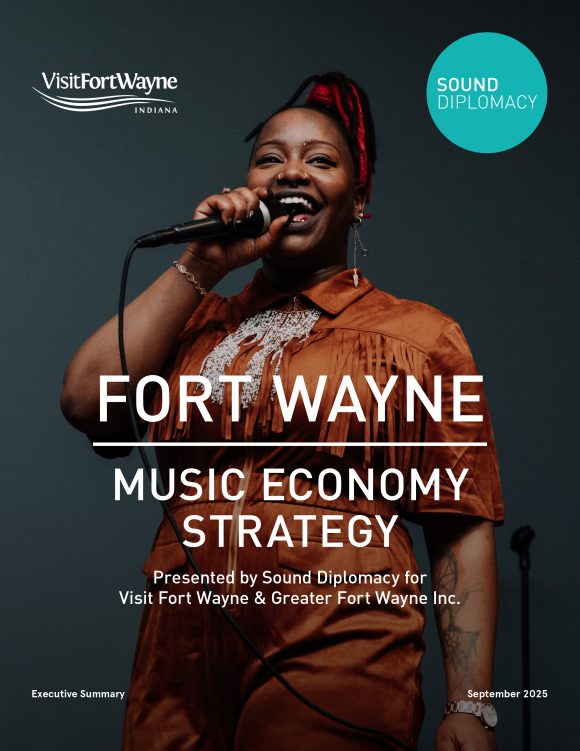
When Pattern launched the Indiana Music Alliance, the goal was to take the spirit of the Indianapolis music strategy and carry it statewide. This summer that turned into a four-city road show, and the timing for our first stop could not have been better. Our Fort Wayne stop landed the day after the city shared its new Music City strategy, and announced the launch of its Music Office, which makes Fort Wayne the first city in Indiana to actually fund a music office. Shout out to Fort Wayne!
There were two conversations in Fort Wayne that day. First a quiet one-on-one with Jessa Campbell, Visit Fort Wayne’s Director of Destination Development and Communications, who led the whole Music Office effort. Then a livelier one, with a handful of venue operators, marketers, and community folks who do this work for a living. Two very different conversations, but I came away from both with the same solid reminder. The study isn’t the hard part. It’s what you do after.
Lots of places can commission a study, run stakeholder sessions, print a report, and say they care about music. The hard part, the part Fort Wayne actually did, is move from study to implementation. They funded a position to carry the work and they are hiring! The funds came from a beautiful public/private partnership between multiple entities: Arts United of Greater Fort Wayne, the City of Fort Wayne’s Community Development division, the Embassy Theatre, Greater Fort Wayne Inc., Surack Enterprises, Sweetwater, and Visit Fort Wayne.
I’ll explain why that’s such a big deal, but first it helps to know how they got there, because the sequence is the lesson.
Fort Wayne’s music work didn’t come out of nowhere. It started inside the Allen County Together plan, which named music as part of the region’s future. Early on the language was about becoming a “top 10 music city,” which predictably made people ask if Fort Wayne was trying to be Nashville. It wasn’t. I don’t know why everyone’s brain goes straight to Nashville, but it does. The point was never to build a strip of honky-tonks. It was to figure out what a music city looks like for Fort Wayne, with its own assets, its own scene, its own version of this.
Visit Fort Wayne first aligned the effort with its tourism master plan, then brought in Sound Diplomacy to conduct the music study. Importantly, the study was not funded solely through visitor dollars. Visit Fort Wayne pulled together a group of partners — including the Knight Foundation Fund at the Community Foundation of Greater Fort Wayne, the Don Wood Foundation, the Northeast Indiana Strategic Development Commission, and Greater Fort Wayne Inc. — to support the work.
Then, when the study was complete, Fort Wayne did the thing so many communities fail to do: it moved immediately into implementation. Visit Fort Wayne helped form a Music Board made up of key civic, tourism, business, and cultural partners, and that group ultimately committed roughly $200,000 a year for the next 3 years to launch and support a dedicated music office. That funding makes it possible to hire what I would call a Music Commissioner: someone whose job is not simply to celebrate the scene, but to implement the strategic priorities of an important economic sector.
Here’s the part that matters for the rest of Indiana. For too long we’ve treated music as either entertainment or nonprofit arts. It gets filed under “things to do,” festival season, downtown activation, quality-of-life language. All of that is true, and all of it is incomplete. Music is also small business. It’s tourism, workforce, nightlife, talent attraction and retention, education, manufacturing, retail. It’s the restaurants and hotels and production companies and studios around every show. It’s one of the main ways a place tells the world who it is. And almost none of that gets counted, because nobody’s responsible for counting it.
That’s what a music office is for. And this is where I want to be precise, to make sure the concept doesn’t get misunderstood. We’re not talking about an entity that books more concerts, or puts live music in restaurants. It’s not going to pursue activations for their own sake. That work has value, but it is not the job. The job is to build the connective tissue: understanding the whole ecosystem, connecting the people who’ve never actually talked to each other, spotting the barriers, tracking what’s working, translating between artists and institutions and policymakers and tourism, and keeping the plan from turning into another nice PDF in your Dropbox folder of strategies you think are cool.
Let me make that concrete, because during our discussion the venue operators said it better than any definition could. One of them made the point that things don’t happen in a city not because nobody has ideas, but because there’s no single point of contact. Joe Citizen wants to throw a block party with live music. How do you get the street closed? Who do you call for a permit? Can you serve drinks? Who runs sound? How do you find out if someone else is planning a block party on the next block for the same weekend? People give up before they start, because the answer to “who do I even ask” is nobody. A music office with at least one full-time staff position is the nobody becoming a somebody. That’s not glamorous, and it’s a long game, but when done right, it changes the trajectory of a community, or even a whole city.
This is where Indianapolis comes in, more as a cautionary tale than anything else. Indy completed a serious (read: expensive!) music strategy in 2019, right before COVID. The recommendations were all there: governance, audience development, artist and industry support, music education, spaces and places, tourism, policy. The work was good. But there was no funded implementation role. No music commissioner. No office whose entire job was to wake up every day and move it forward. So it sat. Seven years later, we’re trying to bring the work back to life through the Indiana Music Alliance, the Indiana Independent Venue Alliance, the Creative Economy Leadership Alliance (CELA), and this statewide conversation. Bottom-line: A strategy without an implementation plan and funding isn’t a strategy. It’s just a really expensive pdf file.
The skeptics in every room want a number. Here’s the number. NIVA’s 2025 State of Live report found that in 2024, independent venues, festivals, and promoters contributed $86.2 billion directly to U.S. GDP, generated $153.1 billion in total economic output, supported more than 900,000 jobs, and returned over $19 billion in tax revenue. That sector out-contributed the U.S. beer, gaming, and airline industries. That’s not a cultural amenity. That’s an economy.
But it’s a fragile one. The same report found that 64% of independent venues were unprofitable in 2024, squeezed by rising costs, insurance, rent, ticketing pressure, and competition from subsidized corporate players. So this scaffolding isn’t optional. It’s the difference between that economic engine surviving in your town or quietly disappearing, one closed music business at a time. That’s exactly the kind of thing a music office exists to see coming and fight.
Which brings me to the rest of Indiana. Elkhart has assets. Bloomington has assets. Madison has assets. Indianapolis has LOTS of assets. But these assets are scattered with nobody responsible for connecting, advocating for, or tracking them. I believe this is a huge miss and a relatively simple challenge to address (not easy, but simple!). Any Indiana community serious about their music economy needs to answer a concrete question: who’s our music person and how can we hire them to do this crucial economic development work?
Not necessarily a city employee. Not necessarily a standalone office on day one. The model can look different everywhere. It might live in tourism, economic development, a chamber, a university partnership, an arts org, or a freestanding nonprofit. But somewhere, there has to be a person with a mandate, a budget, and the responsibility to move the work. Fort Wayne now has that. The other three cities in our pilot, Elkhart, Bloomington, and Madison, are next. That’s the first box to check on a path I’m borrowing fairly openly from Texas.
If Indiana eventually wants an official state office for music, film, and creative industries, and I think we will, we shouldn’t sit around waiting for the state to invent one from the top down. We build the local proof first. Texas figured this out years ago. Its Music Friendly Communities program gives cities a designation they have to earn, a music office or point person, an advisory body, real steps to qualify, and once they’re in, they’re plugged into a statewide office with serious money behind it. The genius of it is the sequence. Cities organize themselves first, and the state support follows the cities, not the other way around. That’s the model I want for Indiana. When four cities here can point to music offices, mapped assets, active venues, audience strategies, real policy needs, and actual economic data, the statewide ask stops being a vague request for support. It becomes an industry organizing itself. That’s a completely different conversation at the Statehouse.
We already know how to do this. We know how to build institutions, align public and private money, market a place, and justify investment when we decide something matters. Music deserves that same seriousness, not only because it drives billions of dollars in economic activity, but because people love music. YOU love music. We travel for it. Some of us build our lives around it. Think about the places that stay with you: the unexpected song coming through an open door, the crowd gathered outside a small venue, the windows glowing, the bass moving through the sidewalk, the feeling that something is happening and you want to be part of it. What we remember is not just the show. It is the feeling of a place alive with sound — strangers moving together, music pulling you down the street toward something you did not plan but are suddenly very glad you found.
A Music City isn’t a just slogan, a mural, or a weekend festival. It’s a place that decided music is part of how it works. Fort Wayne just took the hard first step, not by chasing somebody else’s identity, but by funding a person to do the work. And that’s what a music city actually needs.

