
Creative Adaptive Reuse Is Not About Buildings. It’s About Leverage.
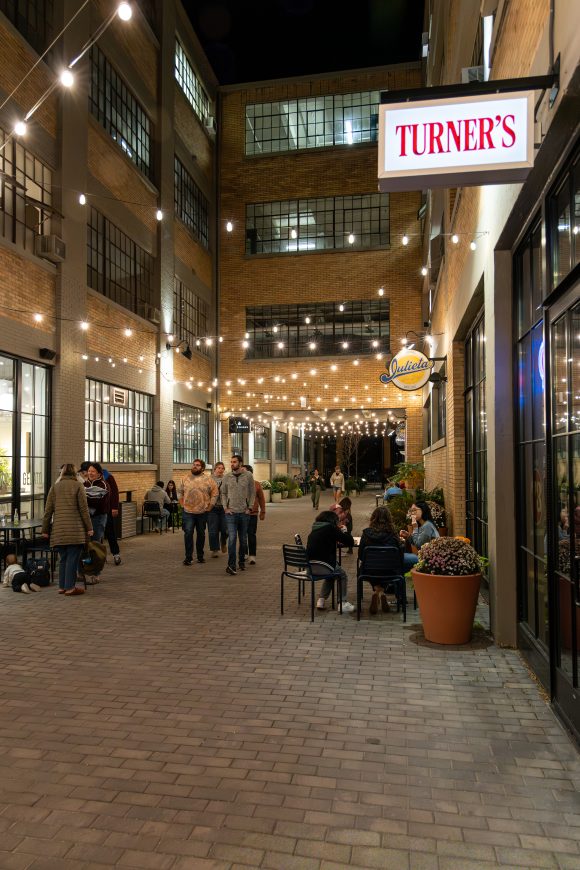
On March 1, we gathered at Katz, Sapper & Miller for the first session in a four-part series exploring how the creative economy intersects with real economic development strategy. The topic was Creative Adaptive Reuse.
About 45 people showed up, representing a pretty wide cross-section of the regional ecosystem. Developers. Architects. Nonprofit leaders. Municipal staff. Economic development professionals. Creative entrepreneurs. Civic partners. A handful of the Pattern team. Several folks from KSM.
In other words, the kinds of people who actually wrestle with what happens to buildings, land, and downtowns when the market shifts and communities have to decide what comes next.
The conversation was anchored by a panel of speakers working directly inside the systems shaping our built environment:
- Dax Norton, Town Manager, Bargersville, Indiana
- Jenell Fairman, Executive Chief of Economic & Community Development, City of Westfield
- Max Engling, Regional Director, Central Indiana, U.S. Senator Jim Banks
- Jeremy Stephenson, Managing Partner, 1820 Ventures
Moderated by Marlon Webb, Manager of Government Consulting, KSM
Together, the group unpacked the policy, financial, and design forces that determine whether adaptive reuse becomes a catalyst for community life or simply another redevelopment project.
If you expected a tidy conversation about art studios and cool coffee shops, that’s not what this was.
This was about tax structure. Incentives. Housing policy. Federal legislation. Parking garages. Opportunity zones. School enrollment trends. And yes, art and creative entrepreneurship.
Because creative adaptive reuse isn’t aesthetic. It’s structural.
At the same time, there is a simple pattern that tends to unfold when underused buildings are activated by creative activity. Artists, studios, and small creative businesses often move into overlooked spaces first. Foot traffic begins to grow. Restaurants and retail follow. Jobs appear. Investment increases. Over time, districts that once struggled with vacancy begin to develop a recognizable identity and renewed economic energy.
Research consistently shows that this type of creative activity produces powerful spillover effects, strengthening local retail, hospitality, tourism, and small business development.
The Real Tension
One of the clearest threads that emerged was this:
We incentivize scale. We rarely incentivize incubation.
Indiana is very good at assembling large deals. We can incentivize data centers. We can court professional sports franchises. We can assemble redevelopment bonds for major mixed-use projects. But we are not yet structurally aligned to make it easy for a creative entrepreneur to rent a storefront for $15 per square foot instead of $40.
That gap is where ecosystems either form or stall.
Housing Is Not Separate From the Creative Economy
The conversation leaned heavily into housing, but not accidentally.
We are dealing with:
- An attainable housing gap
- A “missing middle” crisis
- Multifamily dominating under 40
- Luxury dominating over 55
- School enrollment tied directly to housing type
- Zoning and regulatory costs inflating development 25–40%
Housing is not just shelter. It is talent infrastructure.
When housing becomes unattainable, creatives leave. When creatives leave, vibrancy declines. When vibrancy declines, talent attraction weakens. When talent attraction weakens, economic growth slows.
This is not philosophical. It is mechanical.
Adaptive Reuse as Density Strategy
Cities across the Midwest have already demonstrated how adaptive reuse can catalyze this kind of transformation. Detroit’s Eastern Market district, Columbus’s Franklinton neighborhood, Milwaukee’s Historic Third Ward, and Cincinnati’s Over-the-Rhine all began their revitalization cycles by repurposing older buildings and creating space for creative production, small businesses, and mixed-use development.
Different places. Same pattern.
The RESIDE Act, which recently passed the U.S. Senate as part of the 21st Century ROAD to Housing Act, adds a new dimension to this conversation.
Up to $100M annually could be unlocked to convert blighted buildings into housing, particularly where projects include:
- Mixed-use components
- Adaptive reuse
- Affordable (up to 120% AMI) units
- Deregulation efforts
That is not a creative program. But it could be a creative accelerator.
Because density creates customers. Customers sustain storefronts. Storefronts enable creative producers. Creative producers build identity. Identity attracts talent. This is the snowball.
The Incentive Question
Perhaps the most honest moment in the room came when Dax Norton said:
“If we put as much effort into incentivizing the creative economy as we did into recruiting a professional football team, we wouldn’t be sitting here.”
That is not anti-sports. It is pro-alignment. Economic development policy is already interventionist. The question is not whether we intervene. The question is what we choose to prioritize.
- What if redevelopment commissions required ground-floor creative space in incentive packages?
- What if public-private deals included affordable live-work units by design?
- What if policy assumed production matters, not just distribution?
Creative Adaptive Reuse Is an Ecosystem Problem
This panel made something clear:
You cannot solve this at one level.
It requires:
- Federal tools (RESIDE, Opportunity Zones, Historic Tax Credits)
- State layering (READI, small town initiatives, IEDC programs)
- Local policy (zoning, minimums, incentives, parking strategy)
- Developer participation
- Creative sector leadership
It’s a systems conversation.
And Pattern is working hard to map the terrain.
Across Indiana, many communities already have the raw material for this kind of transformation. Vacant storefronts, historic commercial blocks, former schools, and aging industrial buildings are waiting for their next chapter. In many cases, the infrastructure for a stronger creative economy already exists.
The question now is whether we choose to activate it.